Why Parabole

Industrial operations are defined by unknowns.

The problems that move the business (production, reliability, quality, energy, cost) share the same complexity: conditions never seen before, causes that hide behind symptoms, exceptions too rare to learn from. Parabole's platform, TRAIN, was built for exactly that: to reason about the unknown, explain what changed, and identify the action that improves the outcome.

Our customers include leading energy and manufacturing companies across the US and Europe, using our causal AI platform to solve complex operational challenges across upstream, midstream, and downstream.

The problem

The most critical production problems share the same complexity.

Not because they are poorly understood, but because six kinds of uncertainty compound at once.

A question mark inside a lens: operating conditions never seen before.
01

Unseen conditions

Every day creates new combinations of equipment state, materials, operating settings, environment, and human decisions. Most have never occurred before.
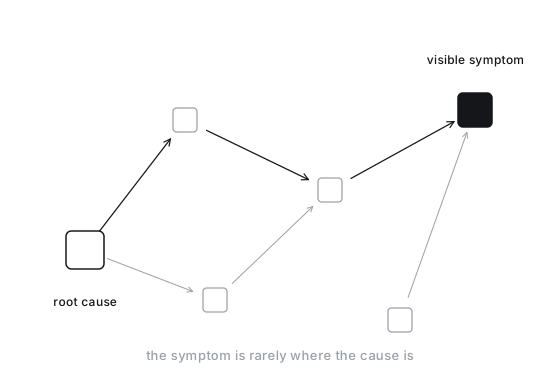
Multiple nodes converging on one point: many causes behind one symptom.
02

Interconnected causes

Thousands of variables interact across assets, processes, and time. The visible symptom is rarely the original cause.
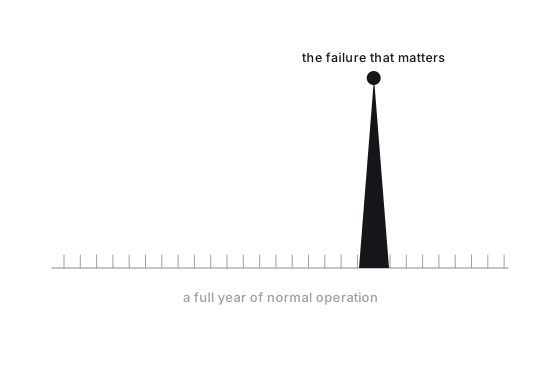
A field of dots with a single flagged outlier: rare, costly exceptions.
03

Sparse exceptions

Failures are rare and expensive. Historical incidents cannot represent every condition the operation will encounter.
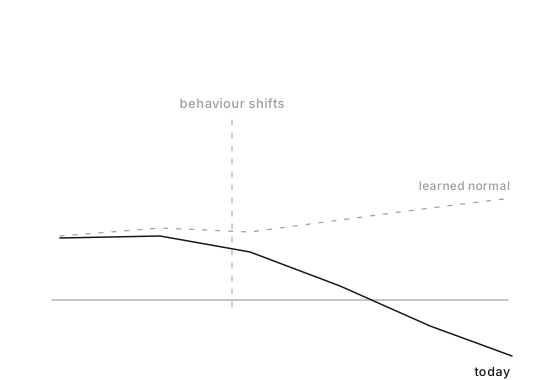
Diverging trend lines rising out of a lens: behavior drifting over time.
04

Changing behavior

Processes, equipment, feedstocks, and operating contexts evolve continuously. Yesterday's model may not represent today's operation.
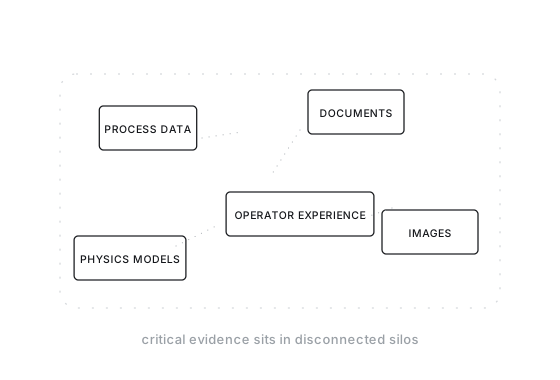
Four disconnected panels around a central node: knowledge held in silos.
05

Fragmented knowledge

Critical evidence is distributed across process data, transactions, images, documents, physics models, and operator experience.
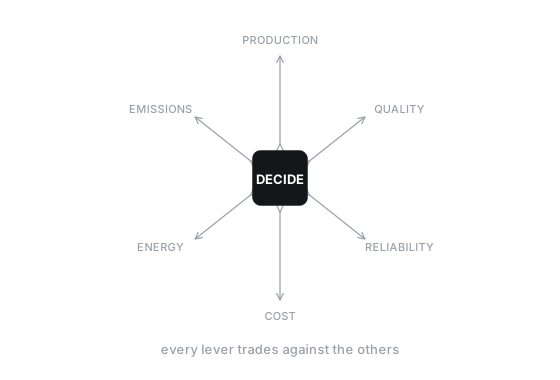
A balance figure bounded by triangles: a decision hemmed in by competing objectives.
06

Constrained decisions

Every intervention has to balance production, quality, reliability, safety, cost, energy, and emissions at the same time.
The stakes

These are must-solve problems.

They determine the outcomes on which the enterprise is measured and address questions operating teams face every day.

What they optimize
RevenueProfitabilityProductivityReliabilityQualityCostEnergyEmissions
What the enterprise must know
What is changing?
Why is it changing?
What happens next?
What action will improve the outcome?
The gap

Most pattern-based AI tools address only part of these operating problems.

Each category addresses part of the operating decision. The missing layer is a governed causal model that connects mechanism, evidence, intervention, and outcome across changing industrial conditions.

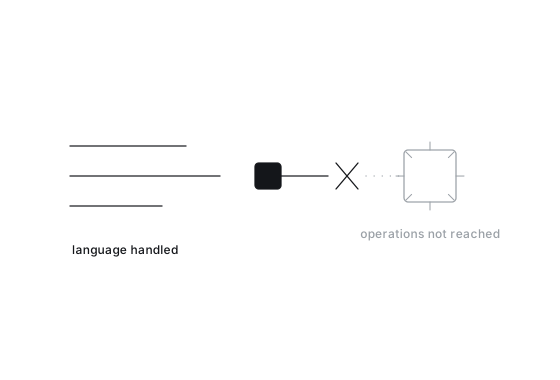
Text lines feed a node, then the link to a machine symbol is broken; language is handled, operations are not reached.
Generative AI

Language fluency alone does not establish operational causality.

General-purpose generative AI is optimized for language. By itself, it does not establish industrial cause and effect or validate operational interventions.

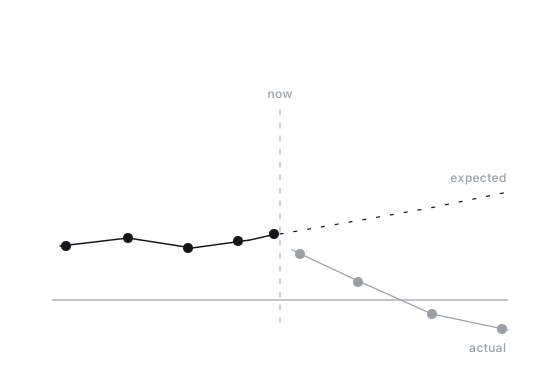
A curve fitted to past points; after 'now', the expected extrapolation and the actual trajectory diverge sharply.
Classical machine learning

Learns from history.

Historical data cannot contain every condition a plant will face. Predictions weaken when equipment, materials, processes, or operating context change.

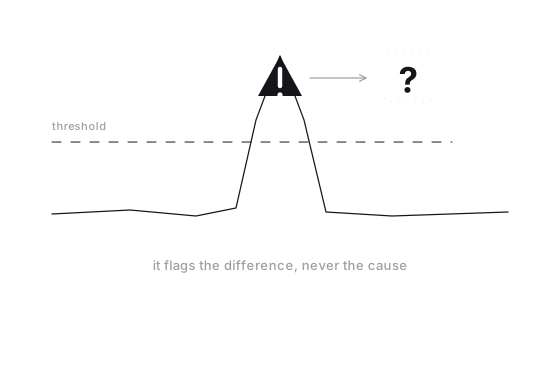
A signal spikes past a threshold and an alert fires, but the arrow leads only to a question mark: no cause, no action.
Threshold anomaly detection

Detection alone does not establish cause.

Threshold-based detection identifies unusual behavior but does not, by itself, establish cause or evaluate interventions. Advanced diagnostic platforms may add those capabilities.

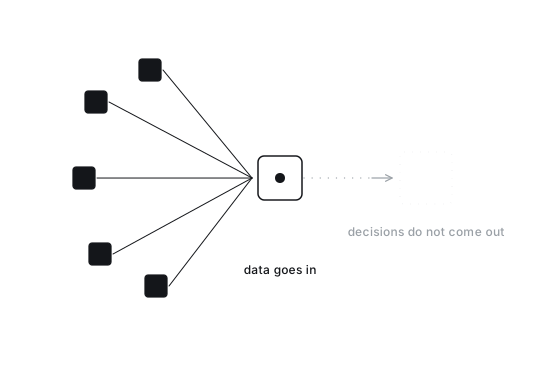
Many data sources converge cleanly on a hub, but the arrow onward to a decision is faded and the decision node is empty.
Data platforms

Organize information, not decisions.

Data and ontology platforms contextualize operational information and support decision applications. TRAIN adds a causal modeling and intervention layer that can use those foundations.

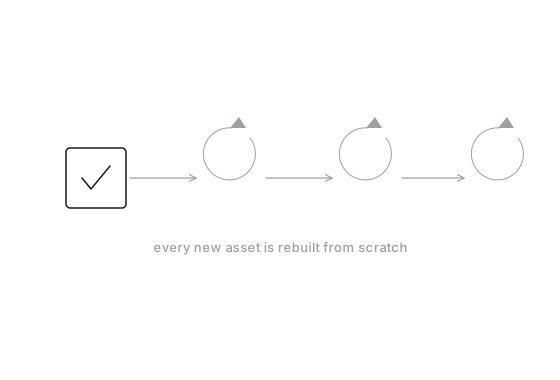
One completed model, then three faded copies each carrying a rebuild-from-scratch loop; effort per asset does not amortize.
Point solutions

Scale within a use case; require work to extend.

Point solutions can scale within a defined use case, but extending them across new assets, sites, or decisions often requires additional discovery, configuration, and maintenance.

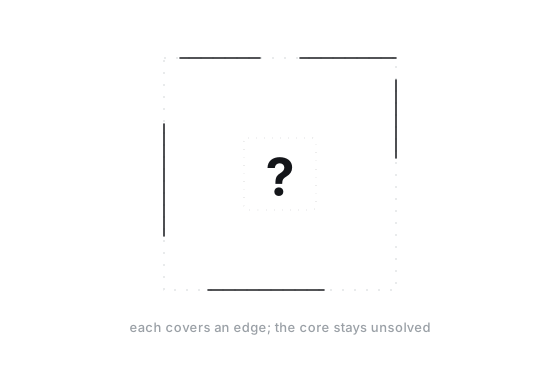
Five short arcs cover parts of a circle's rim while its center stays a dotted, unfilled core marked with a question mark.
The core

Every one of these solves part of the problem. The core stays unsolved.

What is missing is an AI layer that connects what happened, what is likely to happen next, and which feasible intervention can improve the outcome.

The causal advantage

Built to understand the unknown.

One platform, and three ways it changes what an operations team can do on its own.

Business advantage
Operating-model advantage
Technology advantage
Built to understand the unknown and turn it into business advantage.
Understand normal. Explain change. Intervene on cause.
Get started

Ready to put causal inference to work?

Discover how our causal-inference platform, TRAIN, solves the pressing problems in real production environments.

Request a demo